Search for Mediterranean coastal interiors today, and you will quickly encounter the same seductive image: a sun-drenched villa with pale stone, white walls, soft linen and almost nothing interrupting the view.
The attraction is easy to understand.
These interiors promise lightness, simplicity and escape. They offer a visual pause from crowded schedules, constant decisions and the noise of everyday life. For someone moving to the Mediterranean after years of demanding work, or entering a new stage of life in Spain, the all-white villa can feel like a clean slate.
But there is an important difference between an interior that looks peaceful in an image and one that supports peaceful living.
Many of the spaces we see online are AI-generated, digitally enhanced or photographed under highly controlled conditions. Even when the property is real, the image rarely shows how the room sounds, how it feels in the evening, where normal household objects are kept or what happens when people begin to live in it. A photograph captures a moment. A home has to absorb an entire life.
The problem is not the colour white. White can be luminous, calming and deeply connected to Mediterranean architecture. The problem begins when white is expected to do all the work that should have been done by architecture, proportion, texture, storage, lighting and material depth.
Why White Needs Strong Architecture
An all-white interior often appears simple, but it is one of the most demanding aesthetics to execute well.
The more restrained the colour palette becomes, the more responsibility is placed on the architecture itself.
Successful white interiors usually depend on:
- carefully balanced proportions;
- natural light and deep shadow;
- changes in ceiling height and volume;
- material variation;
- precise architectural detailing;
- concealed and well-planned storage;
- strong visual focal points;
- and a thoughtful relationship between indoor and outdoor spaces.
When these elements are present, white can emphasise the architecture and allow light to become part of the composition.
When they are missing, the same palette can make every weakness more visible. A room may begin to feel flat, unfinished or strangely impersonal, even when the furniture and finishes are expensive.
This is why copying the colour palette of a beautiful villa does not necessarily recreate the experience of that villa. The feeling does not come from white paint alone. It comes from everything the white reveals.

From Visual Calm to Everyday Comfort
Many villa owners on the Mediterranean coast arrive after years of demanding professional lives. Others are beginning an active retirement after building careers, businesses and families over several decades. They are often genuinely looking for calm. That is why soft, pale Mediterranean interiors are so appealing. They suggest fewer demands, fewer distractions and more room to breathe. But visual simplicity and emotional ease are not always the same thing.
A room can look quiet while still being acoustically hard, difficult to maintain or visually unforgiving. It can appear spacious in a photograph while offering very little sense of protection or intimacy when someone is sitting inside it.
The question is therefore not whether an all-white villa is beautiful. The more useful question is: What allows this beauty to remain comfortable once real life enters the room?
There are four areas where an all-white interior often needs more support than the photographs suggest.
1. The Stage-Set Effect
Minimal white interiors photograph exceptionally well because they create a clean background. Furniture, people, artwork and views stand out clearly against them.
But a home is not only something to be seen. It is also the place where we need to stop presenting ourselves.
If every surface has to remain visually perfect, a room can gradually begin to feel less like a refuge and more like a set that must be constantly maintained. The space may look relaxed, while the person living in it feels responsible for preserving the image.
This does not mean that a highly minimal home is inherently uncomfortable. For some people, visual restraint is genuinely calming.
The important distinction is whether the simplicity gives you freedom or creates another standard you have to perform.
A sanctuary should not make you feel that you are disturbing it simply by living there.
2. The Tyranny of the Dishwashing Bottle
In a highly restrained white interior, ordinary objects carry far more visual weight.
A jacket placed over a chair, a phone in a coloured case, a collection of books or a green dishwashing bottle beside the sink can suddenly appear to dominate the room.
The objects themselves are not the problem. The problem is that the interior may have no other visual structure strong enough to absorb them.
This is one reason why minimal interiors require excellent storage planning. The aesthetic is not maintained by colour alone, but by understanding how daily life will move through the space.
Where will deliveries be unpacked?
Where will keys, chargers, dog leads and sunglasses accumulate?
What happens when two people are cooking?
Where do the objects that are used every day belong?
Without answers to these questions, visual calm can turn into constant editing and organisation. The owner becomes responsible for restoring the room to its photographed state again and again.
The aesthetic itself is not the problem.
The problem is choosing it without planning for the amount of real life it will need to absorb.
3. The Loss of Spatial Structure
High-quality minimalism is never simply an empty room with white walls.
It is a careful composition of geometry, shadow, scale and movement.
Arches, niches, deep window reveals, changes in material, ceiling lines and built-in elements help the eye understand how the space is organised. They create rhythm and establish a hierarchy between the background and the elements that deserve attention.
In many standard open-plan properties, however, white paint is used as a substitute for this architectural structure.
When every surface has the same colour, finish and visual weight, the space can become difficult to read. Instead of feeling calm, it may feel undefined or strangely tiring. The eye moves through the room without finding a natural place to settle.
White works best when it allows architecture to speak.
If the architecture has very little to say, the interior needs other forms of depth: material contrast, lighting, furniture placement, artwork or carefully designed built-in features.
4. Acoustic Hardness
A room can look visually quiet while remaining acoustically uncomfortable.
Contemporary Mediterranean interiors often combine glass walls, microcement floors, pale plaster, stone and large open volumes. These materials create beautiful continuity and reflect the coastal light, but they may also allow sound to travel and rebound through the space.
The effect becomes noticeable in everyday moments:
- footsteps moving across the floor;
- dining chairs being pulled back;
- several people speaking at once;
- kitchen sounds spreading into the salon;
- a dog walking through the house;
- or the television carrying across an open-plan interior.
Visual calm cannot fully compensate for acoustic tension.
Irregular lime plaster and textured surfaces may soften the visual appearance of the room and scatter some reflections, but meaningful acoustic comfort usually comes from a broader combination of elements.
Rugs, upholstered furniture, curtains, cushions, textile art, books, timber and, where necessary, dedicated acoustic treatments all help the home absorb sound.

What Traditional Mediterranean Interiors Understood
Whitewashed walls are not a modern invention. They belong to the architectural history of many Mediterranean regions and respond beautifully to intense sunlight.
But traditionally, white rarely existed in isolation.
It was balanced by deep shade, timber, stone, terracotta, woven fibres, ceramics and the irregularity of handmade construction. Thick walls created deep window reveals. Shutters controlled sunlight. Beams lowered the perceived scale of rooms. Floors and textiles brought visual and physical weight closer to the body.
These interiors were shaped by climate, available materials and patterns of daily life.
The lesson is not that contemporary villas should imitate traditional houses.
The lesson is that white becomes more liveable when it is given contrast, texture, shadow and something substantial to hold it in place.
If you want to preserve the lightness of the all-white Mediterranean aesthetic while making it work in daily life, three principles are especially important.
Principle 1: Add Depth Through Muted Undertones
Contrast does not have to mean bright or aggressive colour.
The Mediterranean landscape already offers a quieter palette: smoky ochres, warm limestone, raw sienna, muted olive, weathered timber and deep clay tones.
These shades can be introduced through:
- secondary walls;
- built-in niches;
- stone surfaces;
- joinery;
- upholstery;
- rugs;
- ceramics;
- artwork;
- or small architectural details.
Muted undertones create depth without interrupting the calm of the interior. They allow shadows to register more clearly and give the eye a softer place to rest.
In a successful neutral interior, the colours may appear quiet individually, but together they establish a strong sense of atmosphere.
Principle 2: Introduce Acoustic and Spatial Softness
Softness is not only a decorative quality. It affects how a room sounds, how the body moves through it and whether an open space feels welcoming or exposed.
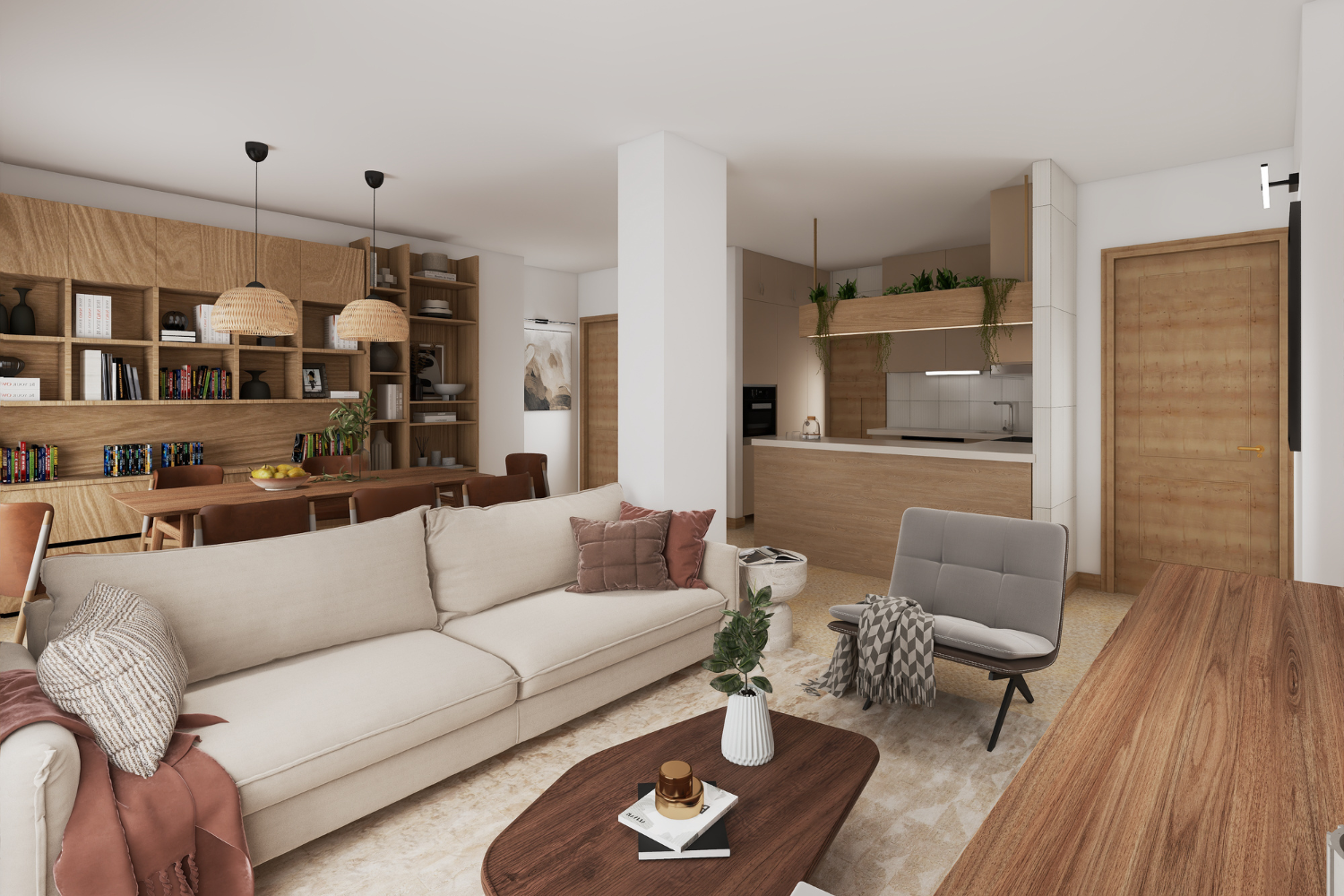
A generously sized rug can define a seating area and absorb footsteps. Upholstered furniture can reduce acoustic hardness. Layered linen window treatments can soften both light and sound without losing the relaxed Mediterranean character.
Textile wall art or woven pieces can add depth to large pale walls while helping to reduce the sense of emptiness.
Furniture placement is equally important.
In a large open-plan room, avoid allowing every piece to float independently. Create smaller relationships: a chair angled towards a view, a sofa protected by a console behind it or a reading corner that feels partially enclosed.
Principle 3: Give Every Room a Centre of Gravity
Large, pale rooms often need a clear visual anchor.
Without one, the eye continues to scan the space, noticing every small object because nothing establishes a stronger hierarchy.
A successful focal point does not have to be loud. It simply needs enough presence to hold the composition together.
There are several ways to create this centre of gravity.
A large-scale piece of art
A substantial artwork can bring depth, texture and emotional character into a pale interior. It gives the eye a clear destination and can make smaller everyday objects feel less visually dominant.
The most effective piece is not necessarily the brightest. It may be the one with the strongest material presence or the clearest relationship to the scale of the wall.
A statement headboard
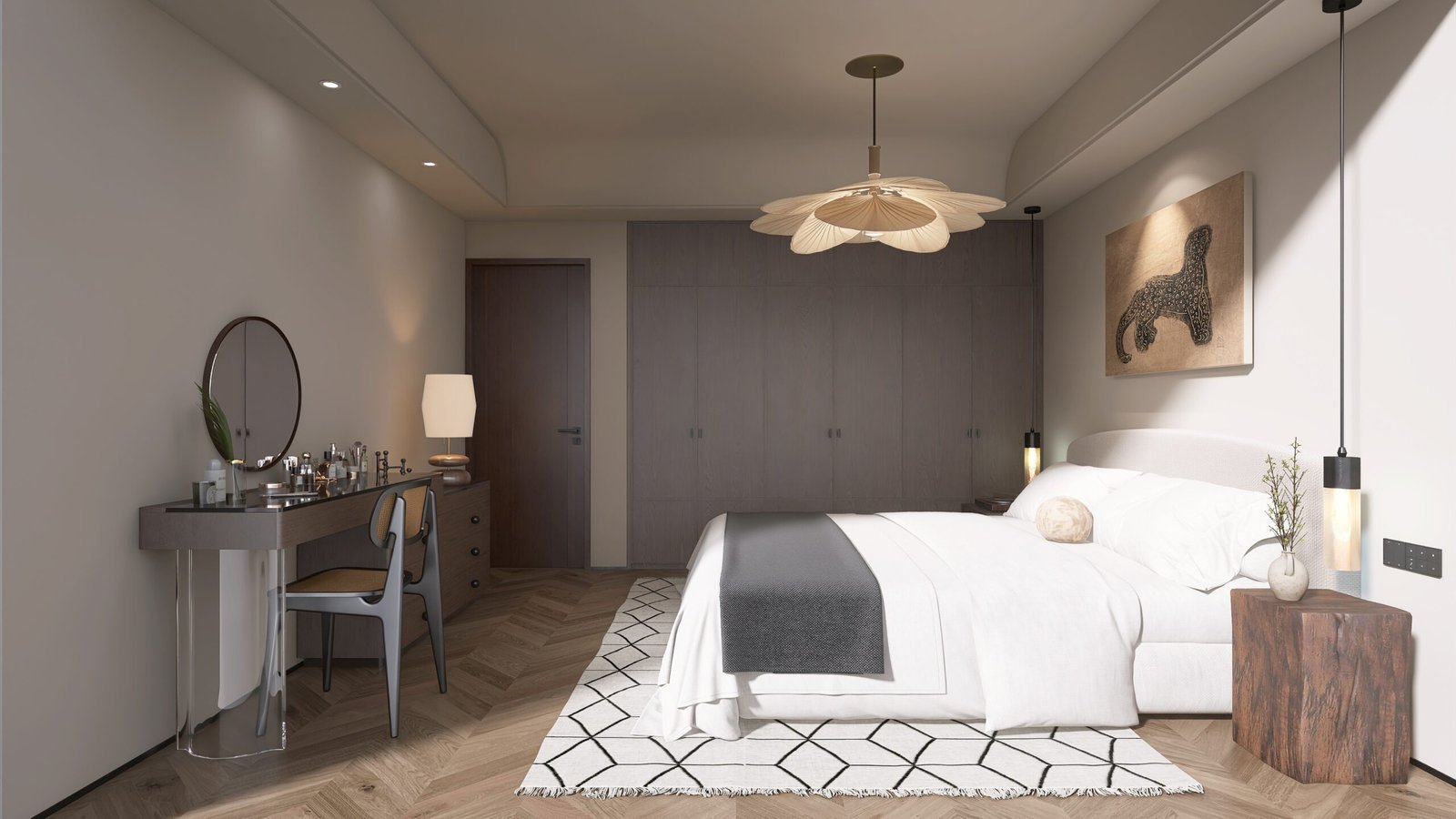
In a bedroom, a tall or generously proportioned headboard can create a sense of enclosure and weight.
It visually anchors the bed, reduces the feeling of exposure and allows the remaining elements in the room to stay restrained.
A sculptural salon composition
A large indoor plant, a sculptural light fitting, a textured coffee table or a carefully arranged group of objects can create a focal cluster within the main living space.
The composition should respond to the architecture and the view.
A focused use of decorative tiles
Patterned or textured tiles can introduce local character without taking over the entire villa.
A kitchen niche, patio wall, bathroom section or fireplace surround can become a concentrated moment of colour and craftsmanship inside a predominantly white interior.
The key is not to distribute decorative features everywhere.
It is to place them where they can give the room identity and visual rhythm.
The White Foundation May Not Need to Disappear
If your all-white villa feels cold, echoing or strangely impersonal, it does not necessarily require a complete stylistic reversal.
The white foundation may still be right for the light, climate and architecture of the property.
What may be missing is:
- clearer spatial hierarchy;
- better storage;
- more material variation;
- acoustic softness;
- stronger focal points;
- or a more personal relationship between the rooms and the people living in them.
This is an important distinction.
The goal is not to replace a style simply because it has become popular. Nor is it to fill a minimal interior with objects until it feels conventional again.
The goal is to understand what the space needs in order to deliver the feeling that first attracted you to the image.
Perhaps you were drawn to the white villa because you wanted calm.
Perhaps you wanted clarity after years of responsibility.
Perhaps you wanted a home that felt lighter than the life you were leaving behind.
These are valid and meaningful desires.
The design question is how to translate them into an environment that remains supportive when the photographs are finished and ordinary life begins.
Beyond the Image
A sanctuary is not defined by how little is visible.
It is defined by how well the space supports the life taking place inside it.
Before changing the colour palette or buying more furniture, it is worth clarifying what you need the home to help you feel.
Do you need greater privacy or openness?
Visual clarity or sensory warmth?
A strong sense of grounding or more freedom and movement?
A space that helps you withdraw, gather people together or move comfortably between both?
Standard style questions often return us to familiar references and recycled images. A more useful starting point is to understand what role the home needs to play in your life.
The Private Atmosphere Code is designed to help you identify these deeper needs and translate them into a clearer direction for your space.
Because the most successful Mediterranean home does not simply recreate the image that inspired it.
It delivers the experience the image promised.